
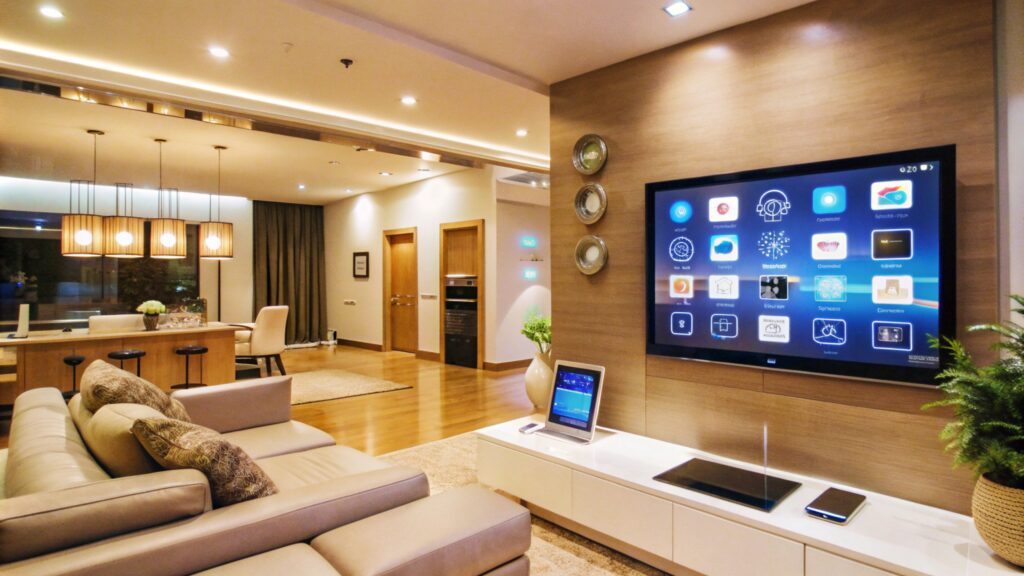
Home has now become not only a place to rest, cook and sleep but also a highly interlinked place where technology can be used to control lightings, security systems, temperature, and use energy effectively.
The rise of smart living has brought about a change in the interaction between people and their residences. Using artificial intelligence (AI), Internet of Things (IoT), and automation systems, routine household tasks have become more convenient and personalized.
The idea that was considered futuristic is now becoming a vital aspect of today’s residential construction. It can be seen that the technology for smart homes is affecting not only the construction of luxurious apartments but also of contemporary family houses.
From Traditional Homes to Connected Living
In conventional houses, manual control is predominant. The lighting switches on and off manually, each appliance operates separately, and the security systems are separate from one another.
Connected devices that can interact with each other make all of these possible within smart homes. Individuals will be able to manage their home environment through phones, voice commands, and even central control panels.
For instance, the homeowner may turn off their lights remotely, monitor their security camera when traveling, and control their air conditioner before returning to their home.
This is made possible by the Internet of Things which facilitates the communication between devices including sensors, appliances, cameras, and thermostats through a network.
In the next phase, the focus is not only on making connections but also on intelligent systems that react to household activities, environmental factors, and user preferences.
Artificial Intelligence Is Making Homes More Intelligent
Artificial intelligence is becoming an important part of the smart home experience.
Past automation methods mostly depended on set guidelines. The lights could switch on at a certain time or an air conditioner would run on a predefined schedule.
The AI-enabled devices have the capacity to enhance these experiences in an adaptive manner. Through analysis of data like occupancy, temperature, and previous user choices, they can assist in identifying what action might be necessary.
Picture a house that automatically alters its lighting in the evenings, changes the temperature according to preference, or even spots any abnormal behavior through its security system.
Voice assistants make our everyday life easier too. The residents may command their compatible devices by using their voice to do different tasks like play music, check information, or manage household routines.
Even though these systems are still under development, the trend is evident – residences are increasingly transitioning from simple automation to smarter living spaces.
Smart Appliances Are Transforming Everyday Tasks
The modern kitchen and household are also experiencing a technological shift.
Connected fridges, washing machines, robots that clean, ovens, and many more household devices are revolutionizing how people handle their daily duties.
Some appliances are integrated such that users can monitor the process remotely through their smartphones. The robotic cleaning devices can follow pre-programmed schedules, while the smart kitchen appliances give more control over cooking and food preparation.
These trends are especially significant for families who lead hectic lives and find that convenience is a major factor.
However, the importance of smart gadgets does not lie in the amount of technology. Rather, it is in their ability to address common problems and integrate well.
Energy Efficiency Is Becoming a Major Priority
Energy management is one of the most significant opportunities for smart home technology.
Smart lighting, thermostats, motion sensors, and intelligent energy management systems may be used to provide insight into household power consumption.
For example, automatic lights could be turned off when no one is using the room, while automatic climate control systems could turn on air conditioning or heating depending on family needs.
Houses that have solar panels and batteries could also get advantages out of intelligent systems for managing the production, storage, and use of electrical energy.
The 2026 study on smart home automation in the Information journal recognizes the importance of AI and Internet of Things technologies in energy management, but also emphasizes the need for real-world validation and interoperability.
The wider objective is to make homes more efficient without compromising comfort.
Security and Safety in the Smart Home
Another sector transforming with connected technology is residential security.
Connected smart cameras, video doorbells, motion detectors, digital locks, and connected alarms can all help homeowners monitor their homes remotely.
Some systems even provide notification in case of abnormal activity, while the use of smart locks that are compatible allows authorized persons to control access without necessarily using normal keys.
There is technology to keep one safe at home. Sensors can detect smoke, water leakage, or other abnormalities and inform the residents accordingly.
However, connectivity brings with it some dangers. Surveillance cameras, locks, and various other connected devices can gather sensitive data, thus raising issues of cybersecurity and privacy.
Homeowners need to have good strong passwords, install any security upgrades possible, make sure their Wi-Fi is secure, and know what info their devices are collecting.
A perfect smart home must ensure convenience to its inhabitants without putting their privacy and security at stake.
How Smart Living Is Influencing Real Estate
Smart technology is gradually beginning to be discussed in relation to modern housing developments.
For real estate developers, for architects and interior designers, technology has presented new means by which residential projects can be differentiated from each other. These include automated lights, intelligent air conditioning, digital access systems, and integrated security systems.
The luxury residential estates have especially been very proactive in incorporating technology in their designs; however, the smart home concept is not restricted to luxury homes anymore.
As the availability of connected devices increases, homeowners will be able to incorporate automation slowly by starting with things like lighting, climate control, or security and expand from there.
For the real estate sector, the potential goes beyond integrating smart devices. It requires the creation of homes that incorporate technology within their architectural framework.
The Challenges Behind Connected Living
Despite its advantages, smart home adoption still faces several challenges.
Another challenge can be the expense of purchasing the devices and getting them installed. Another potential obstacle can be that different devices use different systems and thus cannot be managed by a single interface.
There are other considerations regarding privacy. Devices that gather information about household patterns and preferences should have proper data handling procedures.
There is the issue of reliability as well. A house that relies on connectivity technology must also provide tangible methods to control basic functionalities without access to the internet or other connectivity services.
Smart living should be able to become more affordable through the following considerations by the technology providers: affordability, interoperability, security, and usability.
What Does the Future of Smart Living Look Like?
Integration of artificial intelligence, appliances, power systems, and house design would probably be the path of the future for smart houses.
Home will be more effective in predicting needs, coordinating the devices, and helping people to manage their energy usage.
Innovations in intelligent security systems, personalized automation and connected energy management might help in extending the capabilities of residential technology.
On the other hand, a successful smart home will not necessarily have the maximum number of gadgets. It is the one in which technology works in the background to make life easier without complicating things.
Conclusion
Smart living represents a significant shift in the relationship between people and their homes.
Technology is the reason to transform homes into systems of interconnected rooms and devices that work together for efficiency, convenience, safety, and other personal preferences.
As AI and the Internet of Things continue to evolve, smart home technology will gain greater significance in residential architecture, interior design, and real estate.
In conclusion, the intention behind smart homes should not be to complicate life through technology. The idea should be to develop an environment where living is made easier.